

-
Life of Freedom FightersVida de Luchadores por la Libertad
ABIR ABDULLAH1st Part -

|
|
|
|
|
|
|
"You remember
us only for two or three days a year.
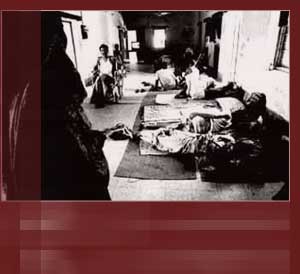
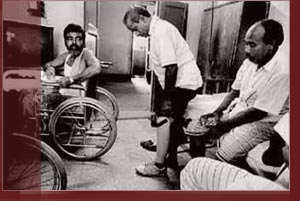
Rest of our time is spent on this floor through turmoil and illness". Thousands of people died fighting for the independence of Bangladesh in 1971 and thousands more lost arms and legs. These injured and disabled freedom fighters who survived even after twenty seven years of Independence, have not yet been properly rehabilitated. Ignored by the nation at large and hidden away from mainstream society, their lives stretch ahead- friendless, jobless and lonely. This photo essay attempts to tell the story of the wounded freedom fighters and their lives. |
|
Life of
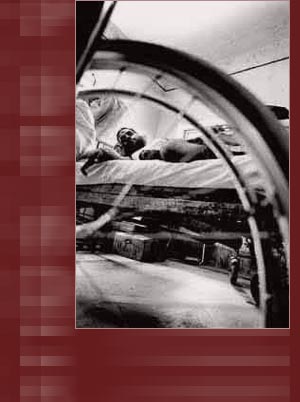
Freedom Fighters "You remember us only for two or three days a year. Rest of our time is spent on this floor through turmoil and illness". The life of wounded and lame freedom fighters who took part in the Independence War of Bangladesh in 1971 is different than that of others in the society. The hopes and dreams that led them to go to war, afterwards came to no fruition.. Before the war, the history was of dependence and ignorance but now added are the uncertainties and trouble of food, clothes and shelter. Many freedom fighters take rest on the floor of the rest house for the wounded freedom fighters near College Gate at Mohammadpur in Dhaka. At times freedom fighters from villages take shelter in this rest house. The year 1971 is in the blood of these freedom fighters. The Father of the nation "Bangubandhu" came many a time and embraced them while he lived. Samsuddin who moves with the aid of a wheel chair says with resentment,"A hundred yards away, Sheikh Hasina the daughter of Bangubandhu lives, and now she is the Prime Minister of Bangladesh, and she does not even come for a day to us." Madhu, one of the wounded freedom fighters, moves from one room to another with the aid of a wheel chair. He does not like to sit idle the whole day. In one day some times he smokes, some times plays his guitar but at night he is sleepless. Madhu's daughter takes care of her father at times. He enjoys launch with his daughter. The freedom fighters who stay at the rest house quarrel with each other. The subjects of their quarrel are politics and their wasted lives and some times even the card games. The wounded freedom fighters didn't get proper medical aid. They could not get good jobs. Their lives are fixed the wheel chair, incapable of motion when no one is there. There is free medical aid from Government but they face difficulties in getting the aid. At first they have to inform about their physical problems to the reserve doctor of the Freedom Fighters Welfare Trust. The doctor then send a report of the patient to The Trust. The patient's condition becomes worse and worse by the time permission comes from the Trust. Eighteen to twenty freedom fighters, who mostly came from outside of Dhaka live in the "Freedom fighter's Village". In the "Village" in every step of daily life the freedom fighters have to obey the rules such as rules for eating , rules for returning etc. Their pocket money is Tk.10 (per day). " We are the guards of this place. We don't know when or where we will be rehabilitated. Above all we are happy enough that we get two meals here and we get a bed with a quilt" said blind freedom fighter Shafiqur Rahman. He was honoured as a "Bir Protik" for his courage in the war. He proudly loves to call himself a "Bir Protik" even though his life is spent in misery. Abul Hossain is another freedom fighter. Two years ago he was watching a drama serial on television called "The Sword of Tipu Sultan" and one scene in the serial that showed Tipu Sultan is being defeated. Abul Hossain had a stroke from the reaction and is now paralysed and unable to speak. Always, Abul Hossain wears a smiling face. His two children stay with their aunt because the honourian that he receives from the Trust can not maintain his family of four. From the stroke, it seems that he has some mental problems too. Some times without any reason he has smashed anything near his hands. His wife said with tears, "I want my husband to talk and walk like a normal man". But Abul Hossain's wife's desire can never be fulfilled because on 19th December 1998, Abul Hossain died, snatching away the smile of his own and his family's. The wounded freedom fighters grow older and because of their age are susceptible to some critical diseases which can not be cured in our country, or treatment is very expensive. As a result, many of them are devoted to God or wear medallions to get free from diseases or think that these are their last moments in this world. After 27 years of independence, the present condition of the freedom fighters indicate that they are not properly evaluated. Still we have time to give proper medical aid to the persons who lost legs or hands or were wounded seriously, for the welfare of country. The country will be properly free when each and every freedom fighter has been rehabilitated. Photography and text by Abir |
 |
 |
|
 |
 |
 |
 |
